

Our story.

A brief history.
In 1548 the former St. Oswald’s priory, which had been dissolved under Henry VIII, became the new St. Catharine’s parish church. Unfortunately this building was largely destroyed in the Civil war siege in 1643.
The second St. Catharine’s church building was built in 1868. Eventually it was deemed not a suitable location for the parish church and was subsequently moved.
Our current church building which is located on the corner intersection of London road and Denmark road, was consecrated in 1915 and has been a vibrant place of worship for the people of Kingsholm and Wotton ever since.
The parish which we serve has for a long time been home to people on the margins of society. The small chapel in Hillfield Gardens (next to St Catharine’s) was a place for female lepers to worship. The parish has been the home of the county asylum and workhouse, and today includes the hospital, psychiatric hospital, and many ‘half-way’ houses.

Who we are now.
We are now a vibrant and diverse church community serving the communities of Kingsholm, Wotton, Armscroft and part of Elmbridge in Gloucester. We are a church of diverse cultures and ages (0-100 and every decade between!) that gathers to worship and is sent out to join God’s mission both locally and globally.
Follow the link below to learn about our vision and values.
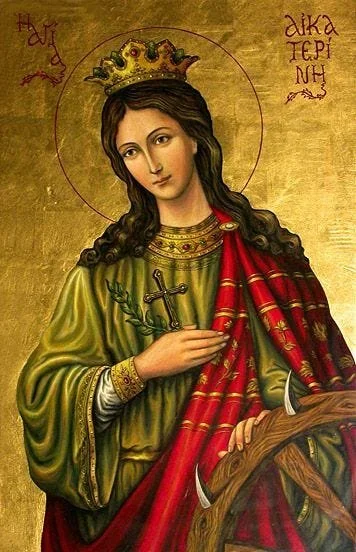
The saint.
According to tradition, Catherine was of a royal family and at the age of 18 she protested against the persecution of Christians by the Emperor Maxentius. Maxentius brought in 50 philosophers to convince her of the errors of Christianity. After prolonged debate some of these philosophers were converted to Christ, but all were killed because of their failure to silence Catherine.
Catherine is said to have refused a proposal of marriage from the Emperor himself and as a consequence was thrown into jail. She then converted all her fellow prisoners and jailers. Maxentius was furious, and ordered her to be tied to a spiked wheel (later called a Catherine Wheel). The wheel broke, and Catherine was subsequently beheaded.
Catherine’s legend flourished throughout the Middle Ages, particularly through the period of the Crusades. She became the patron saint of young girls, students and nurses. Her legend spread partly through paintings and other artistic representations of her life.